E-Commerce SEO vs Traditional Website SEO: Key Differences Explained (2026)
E-commerce SEO and traditional website SEO require fundamentally different strategies. Learn the key differences in keyword research, technical SEO, content, and link building for 2026.

Rikesh Panchal
Google Ads Certified Trainer
Ahmedabad, Gujarat
Part of our complete guide: How to Become an SEO Expert in 2026: A 7-Step Practical Roadmap
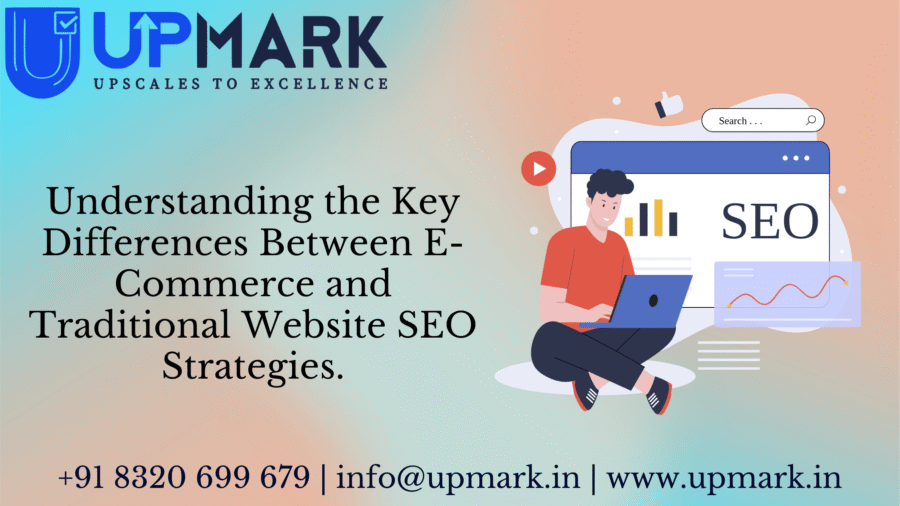
Table of Contents
- 1The Fundamental Difference: Intent and Page Types
- 2Difference 1: Keyword Research Strategy
- E-Commerce Keyword Research
- Traditional Website Keyword Research
- 3Difference 2: Content Strategy
- Content for E-Commerce Sites
- Content for Traditional Websites
- 4Difference 3: Technical SEO Priorities
- E-Commerce Technical SEO Issues
- Traditional Website Technical SEO Issues
- 5Difference 4: Link Building Strategies
- E-Commerce Link Building
- Traditional Website Link Building
- 6Difference 5: Measurement and KPIs
- 7When Do the Two Approaches Overlap?
- 8Practical Checklist: Which SEO Approach Does Your Site Need?
- 9Frequently Asked Questions
⚡ Quick Answer
What is the difference between e-commerce SEO and traditional website SEO? E-commerce SEO focuses on ranking product and category pages for transactional, buying-intent keywords — with emphasis on technical structure, product schema, and managing thousands of pages at scale. Traditional website SEO (for service businesses, blogs, or informational sites) focuses on ranking content pages for informational and commercial keywords, with fewer technical complexities but greater emphasis on topical authority and editorial content quality.
SEO is not one discipline — it is many. The strategies, priorities, and technical requirements for ranking an online store on Google are fundamentally different from those for ranking a service business website or a content blog. Confusing the two is a common and costly mistake made by marketers entering the field.
Understanding these differences is not just academic — it directly affects the keyword strategy you build, the content you create, the technical issues you prioritise, and the results you can realistically expect from your SEO investment.

The Fundamental Difference: Intent and Page Types
The most important distinction between e-commerce and traditional website SEO is the type of pages being optimised and the intent of the search queries those pages need to rank for.
E-commerce SEO targets primarily transactional and commercial intent queries — searches from people who are ready to buy or in the late consideration stage. The pages being optimised are product pages, category pages, and brand landing pages.
Traditional website SEO targets a broader mix of informational and commercial intent queries. The pages being optimised are blog posts, service pages, landing pages, and about-style content.
This fundamental difference cascades into almost every other aspect of SEO strategy.
Difference 1: Keyword Research Strategy
Keyword research for e-commerce and traditional websites requires a different mindset, different tools usage, and different prioritisation.
E-Commerce Keyword Research
E-commerce keyword research centres on product-specific, transactional queries. The goal is to find what potential customers type when they are ready to buy.
Key keyword patterns for Indian e-commerce:
- Product type + brand (e.g., "Nike running shoes men")
- Product type + specification (e.g., "10,000 mAh power bank under ₹1000")
- Product type + use case (e.g., "formal shoes for office")
- Category + location intent (e.g., "buy dresses online India")
- Comparison queries (e.g., "iPhone 16 vs Samsung S25")
Volume vs competition balance: E-commerce SEO often targets medium-volume, high-specificity keywords (like "red cotton kurti women XL") rather than high-volume, broad terms (like "women's clothing") — because the specific queries have much higher purchase intent and conversion rates.
Traditional Website Keyword Research
Traditional website SEO focuses more on informational and educational queries — questions, how-to searches, comparison queries, and "best X" queries — because these drive traffic to blog content and service pages.
Key keyword patterns:
- How to [do something] (e.g., "how to file GST return online")
- Best [service/solution] for [situation] (e.g., "best CA firm for startup")
- [Service] in [city] (e.g., "interior designer in Ahmedabad")
- [Problem] solution (e.g., "water damage phone repair")
Long-tail content strategy: Service businesses build topical authority by covering their subject comprehensively across many blog posts and resource pages, targeting hundreds of related informational queries.
| Aspect | E-Commerce SEO | Traditional SEO |
|---|---|---|
| Primary intent | Transactional, commercial | Informational, navigational |
| Key page types | Product, category, brand pages | Blog posts, service pages, landing pages |
| Keyword focus | Specific product queries, buying terms | Educational queries, service discovery |
| Content volume | Thousands of product pages | Dozens of high-quality content pieces |
| Conversion action | Add to cart, purchase | Lead form, phone call, email |
💡 The Keyword Mapping Rule
In e-commerce SEO, never send transactional keywords to blog pages or informational keywords to product pages. Google understands search intent and rewards pages that match it. A "buy running shoes online" query should land on a category or product page, never a blog post about running. Map keywords to pages based on intent alignment.
Difference 2: Content Strategy
Content is critical for both e-commerce and traditional website SEO — but the type of content, its volume, and its purpose differ significantly.
Content for E-Commerce Sites
E-commerce sites have two primary content challenges:
Product page content at scale: An online store with 5,000 products needs 5,000 unique, optimised product descriptions. Duplicate content (using manufacturer descriptions across multiple pages) is one of the most common technical SEO problems for Indian e-commerce sites.
Every product page needs:
- Unique title tag with primary keyword
- Original, keyword-rich product description (not manufacturer copy)
- Product specifications in structured format
- User-generated content (reviews and ratings)
- FAQ section addressing common pre-purchase questions
- Product schema markup for rich results
Category page content: Category pages are often the highest-volume traffic pages for e-commerce sites. An introductory paragraph (150–300 words) with the category's primary keyword, a clear product grid, and navigational filters helps both users and search engines understand the page's purpose.
Supporting blog content: E-commerce blogs primarily target upper-funnel informational queries to capture potential buyers earlier in their journey. A shoes brand writing about "how to choose running shoes" captures someone researching before they are ready to buy.
Content for Traditional Websites
Traditional websites (service businesses, agencies, SaaS, educational institutions) depend on content quality and depth to establish topical authority.
The content cluster model is the dominant content strategy for traditional websites in 2026:
- Pillar page — A comprehensive, long-form guide on a core topic (e.g., "The Complete Guide to Digital Marketing")
- Cluster pages — In-depth articles on specific sub-topics that link back to the pillar (e.g., "Email Marketing Guide", "Google Ads Tutorial", "SEO Strategies")
- Internal linking — Every cluster page links back to the pillar and to related cluster pages
This structure signals to Google that your site is an authority on the subject, boosting rankings for all pages in the cluster.
Difference 3: Technical SEO Priorities
Both site types need technical SEO — but the specific challenges they face are dramatically different.
E-Commerce Technical SEO Issues
Duplicate content: Product variants (different sizes, colours, specifications) often create near-identical pages. Use canonical tags to point to the primary product URL. Paginated category pages (page 2, page 3) require either canonical tags pointing to the first page or self-referential canonicals.
Crawl budget: Large e-commerce sites with thousands of pages must manage Google's crawl budget efficiently. Prevent Google from crawling and indexing filtered URLs, session IDs, and other URL parameters that create duplicate content.
Site structure and internal linking: Category pages should be reachable in 2–3 clicks from the homepage maximum. A flat, logical site architecture (Homepage → Category → Sub-Category → Product) helps Google understand your site hierarchy and distributes link authority efficiently.
Page speed for mobile: Google's Core Web Vitals are particularly important for e-commerce sites where slow loading directly costs revenue. A 1-second delay in page load time can reduce conversions by 7%. Optimise image compression, lazy loading, and server response times aggressively.
Schema markup: Implement Product schema on product pages to enable rich results in Google Search — price, availability, ratings, and review count shown directly in the search results. This dramatically improves click-through rates.
Traditional Website Technical SEO Issues
Traditional websites typically have fewer pages, making technical management less complex. Key technical priorities:
Page speed and Core Web Vitals: Still critical, especially for mobile users. Aim for a Largest Contentful Paint (LCP) under 2.5 seconds.
Mobile-first indexing: Google now uses the mobile version of your site for indexing and ranking. Ensure your mobile design is as complete and well-structured as your desktop version.
HTTPS and security: Essential for all websites — Google uses HTTPS as a ranking signal.
Indexability: Ensure important pages are not accidentally blocked by robots.txt and are included in your XML sitemap.
⚠️ E-Commerce Duplicate Content Is a Major Issue
Indian e-commerce sellers who list products on their own website using the same descriptions as Amazon, Flipkart, or the manufacturer's catalogue are creating a significant duplicate content problem. Google cannot determine which version is the original and typically ranks the high-authority platform (Amazon, Flipkart) over the brand's own site. Always write original product descriptions.

Difference 4: Link Building Strategies
Backlinks remain one of Google's strongest ranking signals in 2026. But the type of links that move the needle differs between e-commerce and traditional websites.
E-Commerce Link Building
Product PR and reviews: Getting product reviews from bloggers, YouTubers, and journalists generates both backlinks and social proof. Indian tech review sites like 91mobiles, Gadgets360, and lifestyle blogs are valuable link targets for relevant products.
Supplier and manufacturer links: If you stock well-known brands, those brands often link to authorised retailers from their website. Reach out to suppliers and request inclusion on their "where to buy" pages.
Category-specific directories: Industry-specific directories relevant to your product category (e.g., wedding directories for bridal jewellery brands) provide relevant, topically authoritative links.
Comparison site listings: Sites like PriceDekho, MySmartPrice, and Junglee aggregate product listings. Getting listed drives both traffic and a relevant backlink.
Traditional Website Link Building
Guest posting: Publishing expert articles on industry publications and blogs is the cornerstone of link building for service businesses. Each guest post placement builds topical authority and drives qualified referral traffic.
Digital PR: Creating original research, surveys, or data reports that journalists and bloggers cite. A digital marketing agency publishing annual "State of Digital Marketing in India" data can earn dozens of natural backlinks.
Resource page links: Identifying pages that compile resources for your niche and requesting inclusion is a high-efficiency link building tactic for informational sites.
Partnership and association links: Links from industry associations, chambers of commerce (like the Ahmedabad Chamber of Commerce), educational institutions, and accreditation bodies carry strong authority signals.
Difference 5: Measurement and KPIs
Learn SEO for Both E-Commerce and Traditional Websites
Upmark's AI SEO Course covers technical SEO, keyword research, content strategy, and e-commerce SEO — with hands-on practice on real websites. Join 10,000+ students trained in Ahmedabad and online. 200+ hiring partners.
Explore the AI SEO Course →When Do the Two Approaches Overlap?
Some businesses blur the line between e-commerce and traditional website SEO:
Content-led e-commerce: Brands like Nykaa and Mamaearth have built massive organic traffic through blog content (informational SEO) that feeds shoppers into their product funnel. They run both informational content SEO and product/category transactional SEO simultaneously.
Service businesses with online booking: A fitness studio, clinic, or salon might have both a blog (informational SEO) and a booking page (transactional SEO) — requiring elements of both strategies.
SaaS and subscription products: Software companies need informational blog content for awareness and comparison/feature pages for conversion — a hybrid approach.
The rule of thumb: look at what action you want a visitor to take when they land on a specific page, and optimise that page for the intent that matches that action.
Practical Checklist: Which SEO Approach Does Your Site Need?
| If your site has... | You need... |
|---|---|
| Product listings, shopping cart, checkout | E-commerce SEO |
| 100+ product variants and filters | E-commerce technical SEO focus |
| Service pages, appointment forms, consultation CTAs | Traditional website SEO |
| A blog as the primary traffic driver | Traditional content SEO |
| Both a shop AND a blog | Hybrid strategy with clear page-type separation |
| Local physical presence | Local SEO additions to either approach |

📚 Upmark Courses to Advance Your Career
Put this knowledge to work with Upmark's AI-integrated training: AI SEO Course (covers both e-commerce and traditional SEO strategies), AI Digital Marketing Course (6-month complete programme), and Performance Marketing Course for paid acquisition alongside SEO. Classroom in Ahmedabad + Online Live.
Frequently Asked Questions
Is e-commerce SEO harder than traditional website SEO?
E-commerce SEO is generally more technically complex due to the scale (thousands of pages), duplicate content risks from product variants, crawl budget management, and the competitive nature of transactional keywords. Traditional website SEO requires equally sophisticated content strategy but has fewer technical landmines. Both are challenging — the difficulty just comes from different sources.
How long does e-commerce SEO take to show results in India?
For new e-commerce sites in competitive niches (electronics, fashion, beauty), expect 6–12 months of consistent SEO work before meaningful organic traffic materialises. Category pages for less competitive keywords can rank within 3–4 months. Product pages for highly specific long-tail queries can rank faster. Brand new domains need at least 6 months to gain enough authority to compete for most transactional keywords.
What is the most important SEO factor for e-commerce category pages?
Three factors matter most for category page rankings: (1) Title tag and H1 optimised with the primary category keyword, (2) Unique introductory content (150–300 words) that uses the target keyword and related terms naturally, and (3) Strong internal linking from homepage and related category pages. Product-rich, user-friendly page structure with proper filters managed via canonical tags is the technical foundation.
Should I add a blog to my e-commerce website for SEO?
Yes. A blog allows your e-commerce site to capture upper-funnel informational traffic — potential customers in the awareness and consideration stages before they are ready to buy. For example, a kitchen appliance store blogging about "how to choose a mixer grinder" captures buyers before they are in purchase mode, building brand familiarity that converts when they are ready to buy. Blogs also generate backlinks and topical authority that improve your product and category page rankings.
What is product schema markup and is it important for SEO?
Product schema is structured data (code added to your product pages) that tells Google about the product's key attributes — price, availability, ratings, and reviews. When correctly implemented, Google can show this information as rich results directly in search results (stars, price, stock status). Rich results typically see 15–30% higher click-through rates than standard search listings, making product schema a high-value technical SEO implementation for any e-commerce site.
How do I handle duplicate content on an e-commerce site with product variants?
Use canonical tags to designate the primary URL for product variants. For example, if a shirt comes in red, blue, and green — each having its own URL — add a canonical tag on the colour variant pages pointing to the primary product page URL. This tells Google to consolidate ranking signals to one URL while still allowing users to navigate directly to their preferred variant.
Is local SEO different from both e-commerce and traditional website SEO?
Local SEO is a subset of traditional website SEO with additional components specific to physical location businesses — Google Business Profile optimisation, local citations (consistent NAP across directories), location-specific landing pages, and review generation. A digital marketing institute like Upmark in Ahmedabad uses both traditional SEO (blog content, service pages) and local SEO (Google Business Profile, local keywords) simultaneously.
What is crawl budget and why does it matter for e-commerce?
Crawl budget is the number of pages Googlebot will crawl on your site within a given time period. Large e-commerce sites with 10,000+ pages can exhaust their crawl budget on unimportant pages (parameter URLs, out-of-stock product pages, duplicate filter pages) and fail to crawl and index their important category and product pages. Manage crawl budget by blocking irrelevant URLs in robots.txt and using canonical tags to consolidate duplicate versions of pages.
How does Google's AI affect SEO strategy in 2026?
Google's AI Overviews (formerly Search Generative Experience) now appear at the top of many informational search queries, providing direct answers without requiring a click. This affects traditional website SEO more than e-commerce SEO — informational blog traffic is declining for some queries captured by AI Overviews. E-commerce SEO for transactional queries is less affected because AI Overviews are less common for product searches. Both strategies need to focus on content depth, E-E-A-T signals, and structured data to remain visible.
Which SEO approach should I learn first — e-commerce or traditional?
Traditional website SEO is the better foundation for beginners because the concepts (keyword research, content creation, on-page optimisation, link building) are cleaner to learn without the technical complexity of large-scale site management. Once you understand the fundamentals, e-commerce SEO adds the technical layer (structured data, crawl management, site architecture at scale). At Upmark, our AI SEO Course covers both, starting with fundamentals and progressing to e-commerce application.
Master SEO with Upmark's AI SEO Course
Upmark's AI SEO Course covers keyword research, technical SEO, content strategy, e-commerce SEO, and AI tools for search optimisation — everything you need to build an SEO career or drive organic traffic for your business. Classroom in Ahmedabad, online live sessions available. Call +91 83206 99679 to book a free demo class.
Explore the AI SEO Course →Written By
Rikesh Panchal
Founder & Lead Trainer, Upmark Digital Marketing Institute
Rikesh Panchal founded Upmark in 2018 after 6+ years running live digital marketing campaigns for consumer, fintech and D2C brands. He has personally managed ₹50 Cr+ in ad spend and still runs active client campaigns today alongside teaching. Every article and course module he writes is shaped by one question: will this actually get a student hired?
- Google Ads Certified Trainer
- Meta Blueprint Certified
- HubSpot Academy Partner
- Google Analytics 4 Specialist
Found this useful? Share it
Free Demo Class
Ready to turn this knowledge into a career?
Live projects, AI tools & placement support from Ahmedabad's top digital marketing institute.