After 12th Science: How to Choose the Best Course for Your Future in 2026
Confused about what to do after 12th Science? This 2026 guide helps students compare courses, salaries, and career paths to make the right choice.

Rikesh Panchal
Google Ads Certified Trainer
Ahmedabad, Gujarat
Part of our complete guide: Career Scope of Digital Marketing in India 2026: Salaries, Roles & Growth
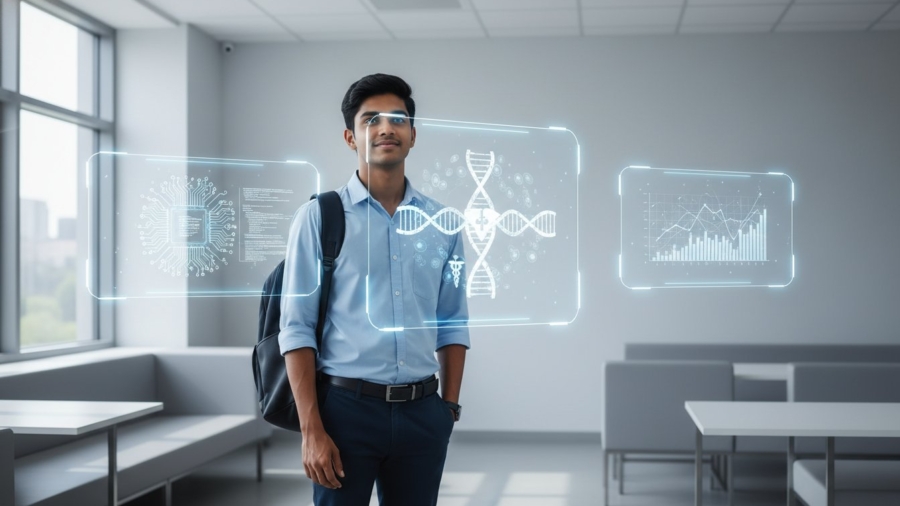
Table of Contents
- 1Step 1: Understand Yourself Before You Choose a Course
- What did you genuinely enjoy studying?
- Are you more analytical or creative — or both?
- What kind of work environment suits you?
- 2Step 2: Map Career Options to Your Stream
- Career Options for PCM Students (Physics, Chemistry, Maths)
- Career Options for PCB Students (Physics, Chemistry, Biology)
- 3Step 3: Understand the Two Paths — Degree vs. Professional Course
- 4Step 4: Why Digital Marketing Is a Standout Option for Science Students
- 5Step 5: Research Before You Commit
- Talk to people already in that field
- Check real salary data
- Visit institutes in person
- 6The Upmark Advantage for Students in Ahmedabad and Gujarat
- 7Your Decision Framework: A Summary
⚡ Quick Answer
How to choose the best course after 12th Science: Start by matching your strengths to career demand — PCM students have strong options in engineering, data science, and digital marketing, while PCB students can explore healthcare, biotech, and life sciences. In 2026, skill-based professional courses in fields like AI and digital marketing often provide faster ROI than a 4-year degree and are equally respected by top employers.
You've just cleared your 12th Science boards — one of the biggest milestones of your life. But now comes the real challenge: choosing what's next. With friends going different directions and parents pushing their own advice, the pressure to pick the "perfect" course can feel paralysing.
Here's the truth: there is no single perfect path, but there is a best path for you — one that aligns your strengths, interests, and the real demand of India's 2026 job market. This guide gives you a clear, step-by-step framework to find it.

Step 1: Understand Yourself Before You Choose a Course
The biggest mistake students make is choosing a course based on what their peers are doing or what sounds prestigious — not what fits them. Before looking at any course catalogue, spend 30 minutes answering three honest questions.
What did you genuinely enjoy studying?
Not "what did you score well in" — but what did you actually enjoy? There's a difference. If Physics problems felt like puzzles you couldn't wait to solve, engineering or data science might be your lane. If you were fascinated by Biology and the human body, healthcare or biotech is worth exploring. If you liked writing, debating, or explaining things to classmates, communications, marketing, or content strategy could be ideal.
Are you more analytical or creative — or both?
Science students often assume they must stay on the technical track. That's outdated thinking. The 2026 job market values hybrid thinkers — people who can combine analytical rigour with creative problem-solving. Digital marketing, UX design, and product management sit exactly at this intersection and are among the fastest-growing fields in India.
What kind of work environment suits you?
Do you prefer working independently on long projects, or do you thrive in fast-paced team settings? Do you want a government job with stability, or are you drawn to startups and entrepreneurship? Your answer narrows down your options significantly.
💡 Pro Tip
Take a free career aptitude test on platforms like CareerGuide or iDreamCareer. These 20-minute assessments give you data-backed direction that's more reliable than gut instinct alone.
Step 2: Map Career Options to Your Stream
Your stream (PCM or PCB) opens different primary doors, but many paths are available to both.
Career Options for PCM Students (Physics, Chemistry, Maths)
| Career Path | Course Duration | Avg. Starting Salary | Entry Route |
|---|---|---|---|
| Computer Science Engineering | 4 Years (B.Tech) | ₹4–8 LPA | JEE / Direct Admission |
| Data Science & Analytics | 6–12 Months | ₹4–7 LPA | Professional Course |
| AI & Machine Learning | 1 Year | ₹5–9 LPA | After B.Tech or standalone |
| Digital Marketing | 6 Months | ₹3–6 LPA | Professional Course |
| Architecture | 5 Years (B.Arch) | ₹3–5 LPA | NATA Entrance |
| Merchant Navy | 3–4 Years | ₹6–10 LPA | Entrance Exam |
Career Options for PCB Students (Physics, Chemistry, Biology)
| Career Path | Course Duration | Avg. Starting Salary | Entry Route |
|---|---|---|---|
| MBBS | 5.5 Years | ₹6–10 LPA | NEET |
| B.Pharm / Pharma | 4 Years | ₹3–5 LPA | Entrance Exam |
| Biotechnology | 4 Years (B.Tech) | ₹4–7 LPA | JEE / Direct |
| Nursing / Allied Health | 3–4 Years | ₹2.5–4 LPA | Direct Admission |
| Digital Marketing | 6 Months | ₹3–6 LPA | Professional Course |
📍 Note
Digital marketing appears in both tables — it's a stream-agnostic field. Your science background (analytical thinking, data interpretation) is actually a major advantage over arts students entering this field.
Step 3: Understand the Two Paths — Degree vs. Professional Course
This is the most important decision you'll make after 12th. Both paths are valid; they just serve different goals.
- Deep theoretical knowledge
- Strong brand value (IITs, NITs)
- Research and postgrad options
- High cost (₹4–20 lakhs total)
- 4+ years before you earn
- Often needs further practical training
- Job-ready in 6 months
- Lower cost (₹30k–1.5L typical)
- Hands-on, project-based learning
- Placement support included
- Less suited for research careers
- Brand recognition varies by institute
The degree path is the right choice if you want to become a doctor, researcher, or engineer at a top MNC — fields where the credential itself is a requirement. The professional course path is the smarter choice if you want to start earning quickly in a fast-moving field like digital marketing, web design, or data analytics.

Step 4: Why Digital Marketing Is a Standout Option for Science Students
If you're a science student who hasn't seriously considered digital marketing, this section is for you. Most people associate marketing with creativity alone — but modern digital marketing is fundamentally a data and logic game.
Think about it: SEO requires understanding algorithms and data patterns. Google Ads management is about statistical optimisation of bids and conversions. Analytics involves interpreting complex data sets. These are skills your science training has already started building.
Why this matters for you:
- Science students who enter digital marketing consistently outperform their peers in analytical roles
- The field has a massive talent shortage in India — companies are hiring aggressively
- You can start a career in 6 months, not 4 years
- Freelancing and entrepreneurship opportunities are available from day one
Explore India's Leading AI Digital Marketing Course
Upmark's 6-month program in Ahmedabad covers SEO, Google Ads, Social Media, Content Marketing, and AI tools — with 200+ hiring partners and 95% placement support.
View Course →Step 5: Research Before You Commit
Once you have 2–3 options in mind, go deeper before paying any fees.
Talk to people already in that field
LinkedIn is your best tool here. Search for "Digital Marketing Executive Ahmedabad" or "Data Analyst Bangalore" and send a polite message asking if they'd share 10 minutes to talk about their career. Most professionals are happy to help students.
Check real salary data
Use platforms like AmbitionBox, Glassdoor India, and Naukri's salary insights to see what roles actually pay — not just what course brochures claim. Look at fresher salaries, not just experienced ones.
Visit institutes in person
If you're considering a professional course, always visit the institute. Check the classroom quality, ask to speak with current students, and review the placement record. At Upmark, Ahmedabad, we encourage prospective students to attend a free demo class before enrolling.
⚠️ Red Flag
Be cautious of institutes that promise "100% placement with ₹10L package" without showing you verifiable student testimonials and company tie-ups. Ask for proof — legitimate institutes are proud to share it.
The Upmark Advantage for Students in Ahmedabad and Gujarat
If you're based in Ahmedabad or anywhere in Gujarat, Upmark Digital Marketing Institute has been preparing students for digital careers since 2018. With over 10,000 students trained, a 4.8/5 Google rating, and 200+ hiring partners, our graduates work at brands like HDFC, Zomato, Cipla, and dozens of leading digital agencies.
Our AI Digital Marketing Course is specifically designed for students who want to be job-ready in 6 months — with live classroom sessions, real project work, and dedicated placement support.

Your Decision Framework: A Summary
Which course has the highest salary after 12th Science?
In terms of starting salary, Computer Science Engineering from a top-tier institute (IIT/NIT) leads at ₹8–20 LPA. For students not pursuing engineering, roles in Data Science, Performance Marketing, and Product Management offer ₹5–9 LPA for freshers. MBBS leads for PCB students but requires 5.5+ years of education. Digital marketing offers the best salary-to-time-invested ratio at ₹3–6 LPA after just 6 months.
Can I do digital marketing after 12th Science?
Absolutely — and you'll have an advantage. Science students are trained to think analytically, interpret data, and solve problems systematically. All three skills are in high demand in digital marketing, especially for SEO, paid advertising, and analytics roles. You don't need any prior marketing knowledge to start.
Is a professional course better than a degree for getting a job?
It depends on the field. For careers requiring a licensed credential (doctor, engineer at an MNC, government jobs), a degree is non-negotiable. But for digital marketing, web design, data analytics, and content creation, a professional course often gets you hired faster and at a similar starting salary — with a fraction of the time and cost investment.
What are the best short-term courses after 12th Science?
The top short-term courses for science students in 2026 are: AI Digital Marketing (6 months), Data Analytics with Python (6–12 months), Web Design and Development (6 months), Cybersecurity Essentials (3–6 months), and Graphic Design with AI tools (3 months). All of these offer strong job prospects within a year of completion.
Do I need entrance exams for all courses after 12th?
Most traditional degrees require entrance exams — JEE for engineering, NEET for medical, NATA for architecture. Professional courses, however, typically have a direct admission process based on interest and aptitude. At Upmark, for instance, admission requires only a brief counselling call to assess your goals.
Which is better after 12th — PCM or PCB for the future?
Neither stream is objectively "better" — they open different doors. PCM gives you access to engineering, data science, architecture, and technology fields. PCB opens up medicine, biotech, pharma, and life sciences. Both streams provide access to digital marketing and business fields. The better stream is the one you chose because you genuinely enjoy those subjects.
How do I choose between engineering and digital marketing after 12th?
Ask yourself two questions: Do I enjoy building technical systems (code, machines, infrastructure)? And am I willing to invest 4 years and ₹5–20 lakhs in a degree? If yes, engineering is your path. If you want to start earning within 6 months in a creative-yet-analytical role and prefer the business and marketing world over pure technology, digital marketing is the smarter move.
Is digital marketing a good career for girls after 12th Science?
Digital marketing is one of the most gender-equal fields in India. Women hold senior leadership positions at top agencies and brands, and the work-from-home flexibility makes it particularly suitable. Many Upmark female graduates have gone on to launch their own agencies or lead marketing teams at large companies within 2–3 years of completing the course.
What is the scope of digital marketing in India for the next 5 years?
India's digital advertising market is projected to reach ₹50,000 crore by 2028, growing at 25–30% annually. With over 800 million internet users and rapid smartphone penetration, businesses across every sector are investing heavily in digital marketing talent. The demand for skilled digital marketers far exceeds supply, making this one of the most job-secure careers you can choose in 2026.
Can I start freelancing in digital marketing while studying?
Yes — and many students do. Once you complete 2–3 months of a professional course, you have enough skills to take on small freelance projects. Platforms like Fiverr, Upwork, and LinkedIn are excellent starting points. Several Upmark students earn ₹15,000–40,000 per month from freelancing even before they complete their 6-month program.
Ready to Start Your Digital Marketing Career?
Join 10,000+ students who chose Upmark to build job-ready digital marketing skills in just 6 months. Classroom sessions in Ahmedabad + online live options available.
Book Free Demo Class →Written By
Rikesh Panchal
Founder & Lead Trainer, Upmark Digital Marketing Institute
Rikesh Panchal founded Upmark in 2018 after 6+ years running live digital marketing campaigns for consumer, fintech and D2C brands. He has personally managed ₹50 Cr+ in ad spend and still runs active client campaigns today alongside teaching. Every article and course module he writes is shaped by one question: will this actually get a student hired?
- Google Ads Certified Trainer
- Meta Blueprint Certified
- HubSpot Academy Partner
- Google Analytics 4 Specialist
Found this useful? Share it
Free Demo Class
Ready to turn this knowledge into a career?
Live projects, AI tools & placement support from Ahmedabad's top digital marketing institute.